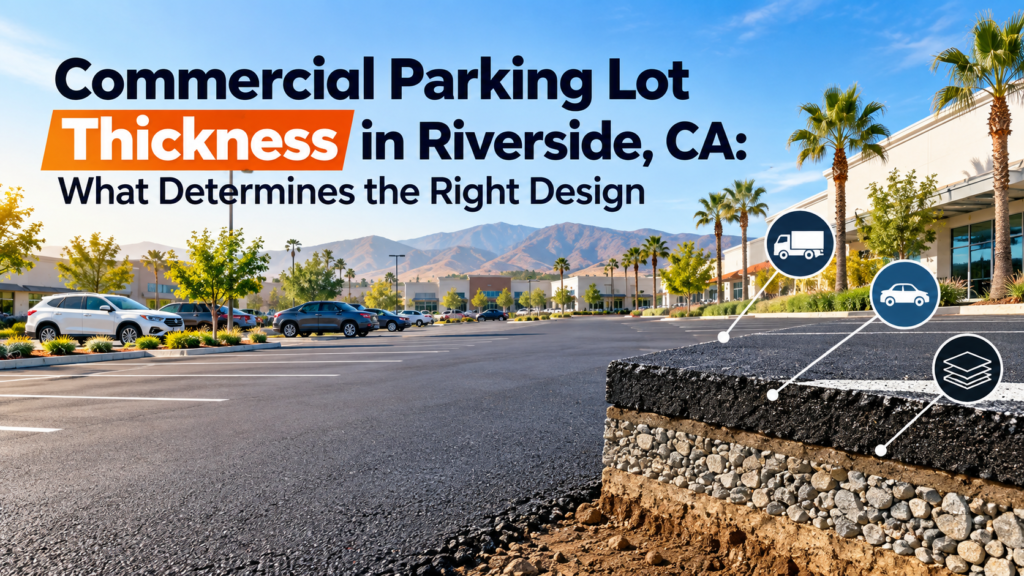
One of the most common questions in commercial paving projects is how thick the asphalt needs to be. It sounds simple, but the answer depends on a web of interconnected factors: the strength of the soil beneath the pavement, the number and weight of vehicles that will use the lot, the asphalt mix design, and the base course material and depth. In Riverside’s Inland Empire setting with its specific soil conditions, intense summer heat, and diverse Commercial Parking Lot Thickness Riverside landscape getting pavement thickness right is the foundation of any successful paving project.
Why Thickness Is a Structural Question
Asphalt pavement is not a monolithic slab that floats on the surface. It is a layered system that distributes loads from the surface down through progressively stiffer layers until the load is spread across the native soil at a level the soil can support without excessive deformation.
When the pavement system asphalt plus aggregate base is thick enough relative to the loads applied, stresses at the subgrade level remain below the soil’s bearing capacity, and the pavement performs well. When the system is too thin, the subgrade deforms under repeated loading, and the pavement above reflects that deformation as rutting, fatigue cracking, and eventual structural failure.
In Riverside’s climate, where summer pavement temperatures can exceed 150°F, the asphalt binder softens reducing the effective stiffness of the pavement structure at the hottest times of day. This thermal softening means that Riverside’s commercial pavement effectively has less structural capacity on a July afternoon than it does on a January morning, even with the same physical thickness. Mix design choices particularly binder grade selection partially compensate for this effect.
Subgrade Strength: The Starting Point for Thickness Design
The California Bearing Ratio (CBR) test is the most common method for quantifying subgrade strength in California pavement design. A CBR value represents how resistant the soil is to penetration under load, expressed as a percentage of the resistance of a standard crushed stone base material. Higher CBR values indicate stronger soil.
Riverside’s soils vary significantly across the city. Areas near the Santa Ana River floodplain have alluvial deposits that may have moderate CBR values, while upland areas with native decomposed granite or rocky soils can have quite high CBR values. Clay-bearing soils, found in parts of the valley, have lower CBR values and are more sensitive to moisture their bearing capacity can drop substantially when wetted.
Soil that will be disturbed during grading is typically compacted to a minimum density often 95 percent of maximum dry density from Proctor testing before base and asphalt are placed. In some cases, lime or cement treatment of the subgrade is used to stabilize expansive clay soils and increase their effective CBR, which can reduce the required base and asphalt thickness.
Traffic Loading and Equivalent Single Axle Loads
Traffic loading for pavement design is not simply vehicle count it is expressed as Equivalent Single Axle Loads (ESALs), which normalize different vehicle types and weights to a common reference load. A standard passenger car generates roughly 0.0003 ESALs per pass; an 18-wheel truck can generate 1 to 4 ESALs per pass depending on its load. The cumulative ESAL exposure over the pavement’s design life drives the thickness requirement.
For a commercial parking lot in Riverside that serves primarily passenger vehicles a typical retail or office lot the design ESAL count is modest, and a relatively thin pavement section may be adequate. A distribution center, a restaurant with heavy delivery truck traffic, or a waste hauler facility may generate 10 to 100 times the ESAL exposure of a passenger-car-only lot in the same timeframe, requiring significantly thicker pavement.
Areas within a lot that receive concentrated loads dumpster enclosures, delivery docks, fuel canopies, compactor pads are treated as separate design zones within the lot because their load exposure far exceeds the general parking area. Failing to thicken these specific areas while designing the rest of the lot appropriately is a common source of localized failures.
Typical Thickness Ranges for Riverside Commercial Lots
While every project requires site-specific design, typical commercial parking lots in Riverside follow patterns that reflect local soil conditions and traffic norms. A standard passenger-vehicle parking lot on moderate native soil typically includes 3 to 4 inches of compacted asphalt over 6 to 8 inches of crushed aggregate base. Lots that receive regular delivery truck traffic often need 4 to 5 inches of asphalt over 8 to 12 inches of base. Heavy industrial or warehouse settings with frequent large truck movements may require 5 to 6 inches of asphalt over 12 or more inches of base.
California pavement design guidance from Caltrans, while primarily aimed at highway projects, provides methodology and reference data that is routinely adapted for commercial lot design in the private sector. The Caltrans Highway Design Manual Chapter 600 provides thickness design charts based on traffic index (TI) and subgrade resistance (R-value), which is California’s version of the CBR-based approach used in other states.
Asphalt Mix Selection and Its Relationship to Thickness
The structural contribution of the asphalt layer depends not only on its thickness but on the stiffness of the mix. A stiffer mix one with a higher-performance-grade binder and lower air void content distributes loads more effectively, which can reduce the required thickness for equivalent structural performance.
In Riverside, the dominant concern is rutting resistance in the surface course during extreme summer heat. PG 70-10 or PG 76-10 binders are often specified for commercial lots exposed to slow-moving or standing truck traffic the higher high-temperature grade resists rutting at elevated pavement temperatures. For lots where heavy trucks are not anticipated, PG 64-10 is typically adequate and more economical.
Polymer-modified asphalt (PMA) using styrene-butadiene-styrene (SBS) or styrene-butadiene rubber (SBR) modifiers increases both high-temperature rutting resistance and low-temperature cracking resistance. While Riverside rarely faces cracking-inducing cold temperatures, the rutting resistance benefit of PMA is meaningful for high-stress commercial applications.
Frequently Asked Questions: Commercial Parking Lot Thickness in Riverside
Is there a code-minimum asphalt thickness for commercial lots in Riverside?
Riverside does not prescribe universal minimum asphalt thickness for private commercial lots in the building code. Design is performance-based the pavement must be thick enough to function under the expected loads. City standards for work in the public right-of-way do specify minimum thicknesses for driveways and aprons connecting to city streets.
How does pavement thickness affect the cost of a commercial paving project?
Asphalt and aggregate base material are the primary cost drivers in commercial paving. Increasing design thickness adds material volume directly each additional inch of asphalt over a 10,000 square foot lot adds roughly 50 tons of material. Proper thickness design avoids both over-building (unnecessary cost) and under-building (premature failure and earlier reconstruction expense).
Can an existing parking lot’s thickness be increased by overlaying?
Yes overlay adds structural thickness. However, the additional thickness only helps if the existing base is sound. An overlay on a structurally failed lot will fail quickly as reflective cracking propagates through the new layer. Base repair or full reconstruction must precede overlay in those areas.
What is the aggregate base, and does it count toward the total thickness?
The aggregate base course crushed stone or gravel beneath the asphalt is a critical structural component. It distributes loads to the subgrade and provides drainage. The total pavement section thickness includes both the asphalt and the base course; the asphalt alone does not carry the full structural load.